 Skip-the-line available
 A Half Day at the University of Coimbra: The Ideal Route
Joanina, the academic prison, the Sala dos Capelos, São Miguel Chapel and down through the old town — a worked itinerary built around your library slot.
Half a day is the honest unit for the University of Coimbra. The Biblioteca Joanina itself takes twenty minutes — that is the rule, not a choice — but the hilltop it crowns holds a former royal palace, a ceremonial hall where kings were proclaimed, a chapel with one of Iberia's great organs, a medieval prison and some of the finest views in central Portugal, and beneath it all the old town falls away to the river in a cascade of lanes that UNESCO inscribed alongside the university in 2013. Rushed as a two-hour stop, the place feels like a queue with scenery; given four to five well-ordered hours, it becomes one of the best half days in the country. The ordering is the trick, because one element of the day is fixed — your timed library slot — and everything else should orbit it. This is the route we would walk ourselves, hour by hour, from the top of the Alta down to a pastry in the Baixa, with the reasons for each choice.
The shape of the half day — everything orbits the slot
Build the day from one fact: the Joanina admits you at the time on your ticket, in a small group, for about twenty minutes, and nothing else on the hilltop is timed. So the itinerary logic writes itself — book the library slot first, then wrap the flexible spaces around it. Our default recommendation is a mid-morning slot: early enough that the halls are calm and the light on the courtyard is good, late enough that a train from Lisbon or Porto delivers you unhurried. With a 10:30 or 11:00 library entry, the half day runs roughly 10:00 to 15:00 and nothing in it feels compressed.
Arrive at the top of the Alta a good half hour before your slot. That margin covers the two things first-timers always underestimate: the climb — a steep ten-to-fifteen-minute ascent from the lower town, however you slice it — and the Paço das Escolas itself, the great courtyard that stops people mid-stride. Bounded by the palace, the library and the balustrade with its long view over the Mondego, with the clock tower above, the courtyard is the visit's establishing shot. Take it in on arrival, deliberately, so you are not trying to absorb it while watching the minutes to your entry time.
One structural note before the walking starts: the university observes that the non-guided ticket's untimed spaces are valid across two days. For a half-day plan you will not need the second day — the route below fits comfortably — but the provision is a quiet safety net. If a train runs late or the courtyard swallows an hour, the palace and museums can slide to tomorrow morning without drama. Knowing the fallback exists is itself worth something: it lets you walk the day at looking pace instead of completing pace.
First hour: the Joanina — and the prison beneath it
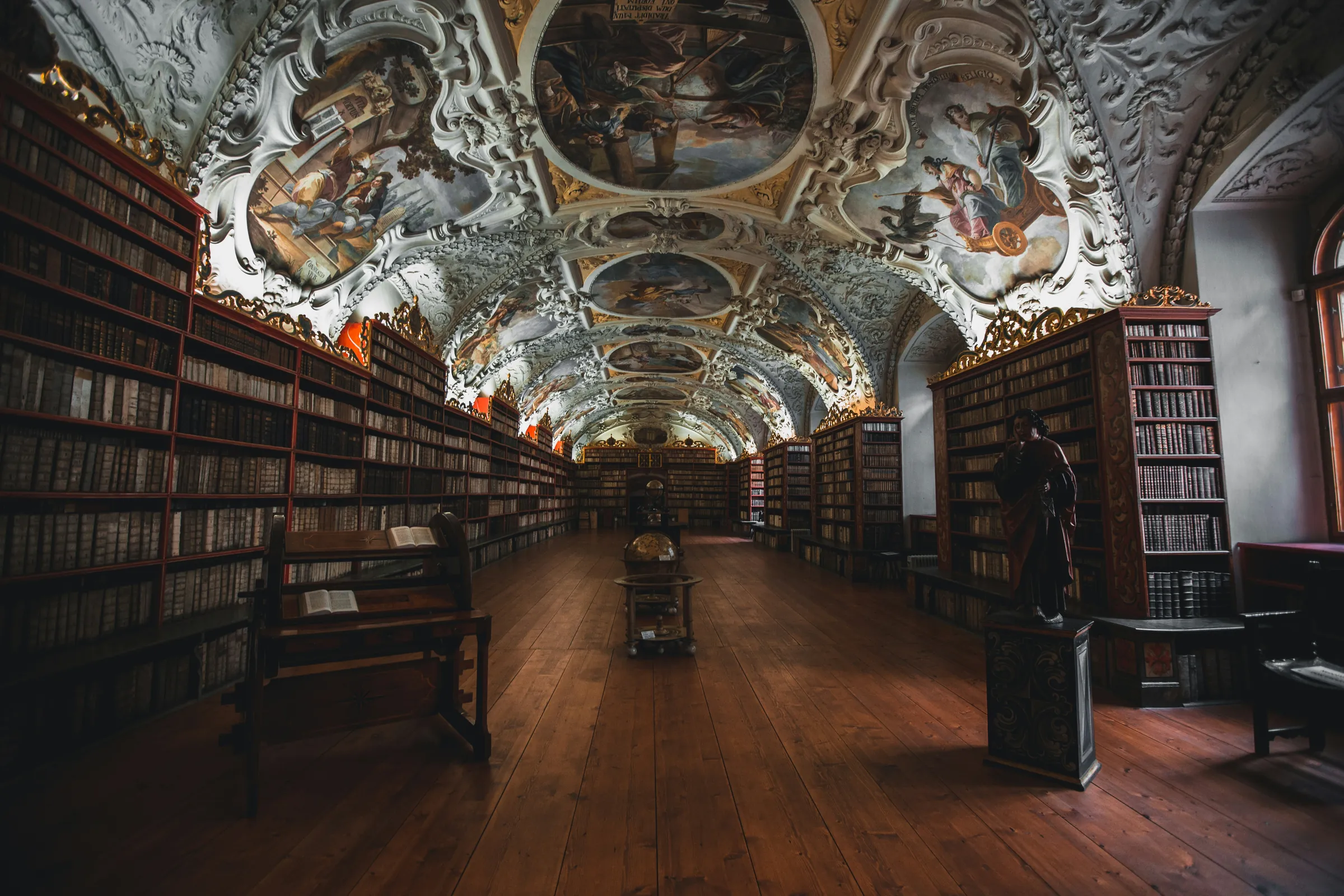
Take the library at your appointed time, and take it properly: phone away — photography is prohibited on the noble floor — and eyes up. Spend your first minute on the long axis, looking down the three halls to the portrait of João V; then let the sequence of ground colours carry you, gilded ornament against black in the first hall, red in the second, green in the third, with the great tropical-wood tables below and the painted ceilings above. Twenty minutes rewards a plan: one good look at the whole, then genuine attention to a case or two, rather than a thin pass over everything.
The visit route also takes in what lies beneath the gold, and it is one of the complex's genuine surprises: the academic prison. The University of Coimbra held its own jurisdiction over students for centuries, and prisoners were kept here — first in a medieval-origin lockup described by the university as the oldest preserved prison in Portugal, with two narrow cells reached by a winding staircase, then from 1782 in expanded quarters beneath the library floor, with communal cells and a visiting room, until the prison closed in 1834. Standing in the bare stone under one of the most extravagant rooms in Europe is a contrast no one forgets.
The prison rewards two minutes of imagination. The offences that landed students here were the perennial ones — debts, duels, disorder — and the sentence was served metres below the kingdom's most precious books, in a building that thus held both the reward of scholarship and its punishments in a single vertical section. It is also blessedly cool and quiet after the choreography upstairs, which makes it a natural place to let your library group disperse before you step back into the courtyard and the day's second act.
Second hour: the Royal Palace and the Sala dos Capelos
Cross the courtyard into the Royal Palace, and recalibrate what the building is: not a university hall dressed up as a palace but an actual one — a fortress site from the 10th century that became, in 1131, the residence of Afonso Henriques, Portugal's first king. Kings of the first dynasty lived here; the university, arriving definitively from Lisbon in 1537, installed itself in the palace by 1544 and never left. The palace circuit is unhurried and untimed — the antidote to the library's clock — and its rooms carry more raw Portuguese history per metre than almost anywhere in the country.
The Sala dos Capelos is the climax. This was the throne room, and the university calls it its most important space: the hall where João I was proclaimed king in 1385, later re-dressed in the 17th century with Lisbon tiles and a ceiling of 172 painted panels, and hung with portraits of Portugal's kings from Afonso Henriques to Manuel II — pointedly omitting the Spanish kings of the Philippine interlude. Today it is where the university's grandest ceremonies and doctoral rites take place, which is the room's quiet lesson: in Coimbra the monarchy ended, but the hall kept its function of conferring dignity; only the recipients changed.
Give the supporting rooms their minutes too. The Private Examination Room — once the king's quarters — is where, until the reforms of the mid-18th century, graduates faced an oral examination held at dusk, beneath a 1701 ceiling painted with the heraldry of the historic faculties; the Arms Room houses the halberds of the academic guard, who still appear in ceremonial dress at doctoral occasions. These rooms are small and quickly seen, but they are the connective tissue between palace and university — the spaces where royal furniture became academic furniture without anyone quite deciding when.
Third hour: São Miguel Chapel, the museums and the tower question
St Michael's Chapel is the half day's change of key. Its origins are 11th-century, its present form is 16th-century, and its interior is a jewel of azulejo tilework crowned by the famous baroque organ — a gilded instrument of roughly 2,000 pipes installed in the 1730s, its trumpetry erupting from the case like a fanfare frozen mid-blast. The chapel still hosts services and concerts, and one scheduling note matters: on Sundays it closes to visitors from late morning into early afternoon for mass, so Sunday visitors should take the chapel first or last rather than at the natural mid-route moment.
If your ticket is the fuller circuit, the university's science collections close the hilltop loop: the 18th-century chemistry laboratory — a rare survivor of Enlightenment teaching science — with the academic museum, the cabinet of curiosities and the mineral gallery nearby. How long they deserve depends on you: a browsing half hour for most visitors, considerably more if historical instruments and specimen cabinets are your weakness. They are the right final indoor act because they are genuinely interesting yet low-intensity — after the library and the throne room, attention needs somewhere gentler to land.
And the tower — the question everyone asks in the courtyard. The university's clock tower is the summit of the composition and the city's timekeeper, its bells governing academic life for three centuries; the views from the hilltop that it anchors are already superb from the courtyard balustrade. At the time of writing, the university's visitor pages list the tower as closed to general visits — it appears only in occasional evening programmes in summer — so treat any climb as a bonus to be confirmed for your dates, not a plank of the plan. The courtyard view over the Mondego costs nothing and disappoints no one.
The descent: old town, cathedral quarter and the Baixa
Leave the hilltop the slow way, downhill through the Alta, and the half day gains its second half. UNESCO's 2013 inscription deliberately covers more than the campus: it takes in the upper town's lattice of medieval streets and, below, the Rua da Sofia with its 16th-century colleges — the street where the university's presence in the city first put down roots. The descent through the student quarter is steep, stepped and constantly photogenic; broken shins are avoidable with decent shoes and unhurried pace, and every landing seems to open another angle back up at the tower or out over the river.
The cathedral quarter makes the natural mid-descent pause. Coimbra's old cathedral is the fortress-faced Romanesque anchor of the Alta, and the lanes around it hold the cafés and miradouros where the climb's effort is repaid; lower down, the city's monastic and collegiate churches thicken towards the Baixa. None of this needs a plan — the topography does the routing, since effectively every downhill line ends at the river — and the reward for wandering is the ordinary theatre of a working university city: students in black capes, laundry over doorways, fado drifting from an open window in term time.
End in the Baixa, the lower town, at looking-back distance. From the riverside or the Largo da Portagem you can trace the whole morning in one upward glance — river, rooftops, Alta, tower — which is the correct final image of a place built to be looked up at. If the day has an evening in it, Coimbra's own fado tradition, sung by men in academic dress, is the classic close; if a train is waiting, the central station sits conveniently at the bottom of the town you have just walked. Either way you leave having done the thing properly: the twenty minutes of gold, and the four hours of city that give it meaning.
Frequently asked
How long do you need for the University of Coimbra?
Plan four to five hours for the full experience: the 20-minute Joanina slot, the academic prison, the Royal Palace and Sala dos Capelos, St Michael's Chapel, the museum spaces and an unhurried descent through the old town. The hilltop monuments alone take two to three hours.
What order should I visit the university in?
Let the library slot anchor everything — it is the only timed element. Arrive thirty minutes early for the courtyard, take the Joanina and prison at your slot time, then the palace and Sala dos Capelos, then the chapel and museums, and finish by walking down through the old town.
Can you climb the university tower?
At the time of writing the university's visitor pages list the tower as closed to general visits, with access appearing only in occasional summer evening programmes. The courtyard balustrade already gives a superb view over Coimbra and the Mondego.
Is the visit suitable for people with limited mobility?
It is demanding: the university tops a steep hill, and the historic interiors involve stairs — the university notes the Royal Palace is not wheelchair accessible and library access is restricted. The two-day validity of the untimed spaces helps split the effort; contact us and we will confirm current arrangements.
Does the half day work as a day trip from Lisbon or Porto?
Comfortably. Fast trains reach Coimbra-B in about 1¾ hours from Lisbon and about 1¼ from Porto, with a short shuttle into the centre. Book a late-morning library slot, and the half day fits between arrival and an early-evening train home.
What is the Sala dos Capelos?
The former throne room of the royal palace — where João I was proclaimed king in 1385 — now the university's great ceremonial hall, with a 172-panel painted ceiling and portraits of Portugal's kings from Afonso Henriques to Manuel II. It is included in the circuit ticket.