 Skip-the-line available
 What to See Inside the Biblioteca Joanina
The three gilded halls, the black-red-green colour scheme, the trompe-l'oeil ceiling, the academic prison below and the wider Paço das Escolas.
You get 20 minutes inside the Biblioteca Joanina, so it pays to know exactly where to look before you step through the heavy door. The library's noble floor is not one room but three, arranged one behind the next like the naves of a basilica, each framed by a gilded arch and saturated with gold leaf, exotic wood and painted illusion. Below the gilding lies a darker story — a working floor and, beneath it, the university's medieval prison. And the same combined ticket that gets you into the library opens the rest of the Paço das Escolas: the Royal Palace with its Great Hall of Acts, the dazzling St Michael's Chapel and its baroque organ. This guide walks you through what to fix your eyes on inside the library itself, then what the wider university holds, so none of it passes you by in the rush of a timed visit.
The three gilded halls and the colour scheme
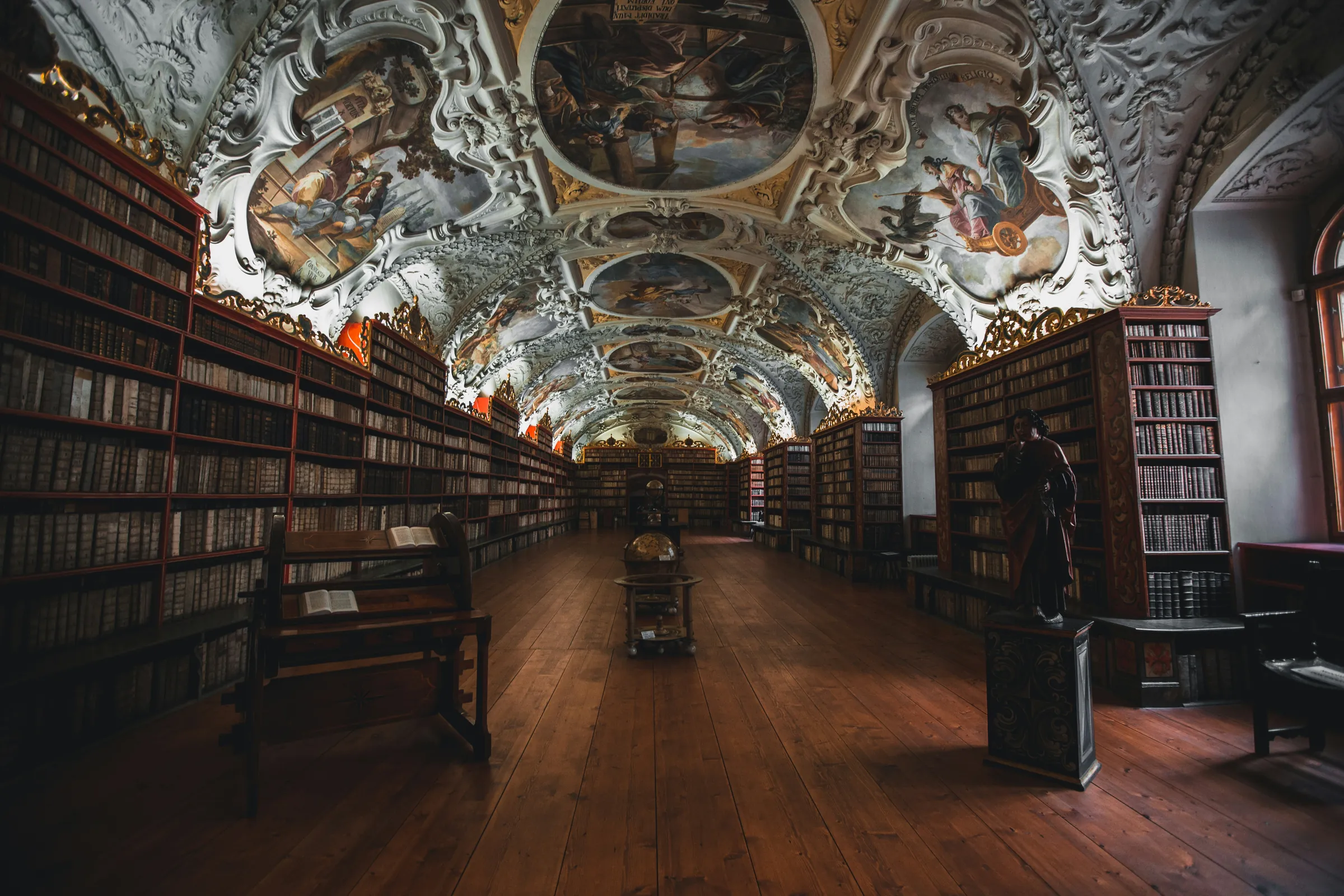
The noble floor is the part everyone pictures: three halls in a line, separated by gilded arches and lined with two storeys of shelving and balconies in dark, exotic woods brought from Brazil. The genius is in the colour. Each hall is decorated with gold against a different ground — the shelving and carved balconies are painted and lacquered over backgrounds of green, red and black, so that walking the length of the library carries you through a deliberate shift of mood from one room to the next. Six long tables in tropical hardwood run down the centre, and a portrait of King João V — the 'Joanina' is named for him — presides over the space he paid for with Brazilian gold.
Look closely and the lacquerwork rewards it. The carved shelves and balconies carry Chinese-inspired motifs, the chinoiserie that was high fashion in João V's Portugal and which echoes the decoration on the organ in nearby St Michael's Chapel. The shelves hold around 40,000 rare volumes, printed between the 16th and 18th centuries, on theology, law, medicine, philosophy and science — not props but a real working collection of the age. In 20 minutes you cannot read them, but you can take in the architecture of knowledge they sit within: gold, wood and light arranged to make scholarship feel like a sacred act.
The trompe-l'oeil ceilings
Tilt your head back in each hall. The ceilings were painted in trompe-l'oeil — illusionistic perspective — by the Lisbon artists António Simões Ribeiro and Vicente Nunes, conjuring painted architecture, cornices and openings that seem to extend the real room upward into space that isn't there. The effect is to make the halls feel loftier and grander than their actual dimensions, a baroque sleight of hand that turns a library into a stage set for wisdom. With only 20 minutes inside and three rooms to cross, it is easy to keep your eyes at shelf height and miss the ceilings entirely — so make a point of looking up in each hall, because the painted vaults are as much the point of the Joanina as the gold below them.
The three ceilings are not merely decorative; together they form a programme. Across the halls the paintings personify three manifestations of knowledge — an allegory of the library itself (Bibliotheca), of the university (Universitas) and of the encyclopaedia of all learning (Encyclopaedia). Reading the ceilings as a sequence is one of the most rewarding things you can do with your short time inside: each hall declares a different idea of what knowledge is and how it should be honoured, and the painted illusion lifts the whole conceit literally over your head. It is a reminder that the Joanina was designed as an argument as well as a store of books — a baroque statement that learning, royally patronised, deserved to be enshrined like scripture.
Below the gilding — the working floor and the prison
The Joanina is more than its golden top floor. Below the noble level lies the middle floor, historically used for book conservation and to house the guards who watched over the prison beneath — a plainer, structural space where the stonemasons' marks can still be read on the arches. It is a useful reminder that the dazzling library above sat atop a working institution with its own order and discipline, and that the building was conceived as a whole machine for keeping and protecting knowledge, not just a showpiece room. Depending on the ticket and route, not every visitor sees all three levels, so it is worth asking which floors your visit includes when you plan the day.
Deepest of all is the Academic Prison (Prisão Académica), a survival of the era when the University of Coimbra held its own judicial powers and could jail its own people — a privilege it kept until 1834. The medieval cells, reached by a winding stair, once held offenders whose crimes ranged from the academic to the petty: cheating in exams, falling asleep in class, or stealing books from the very library above. There were ordinary cells and two cramped solitary-confinement cells nicknamed the 'Secrets'. To stand in this dim stone undercroft, directly beneath the most beautiful library in Portugal, is to feel the full vertical span of the institution — punishment at the bottom, gilded learning at the top.
The rest of the Paço das Escolas on your ticket
Your combined ticket does not stop at the library. The Royal Palace — the Paço das Escolas — was once a royal residence, donated in 1537 to become the heart of the university, and its grandest room is the Sala dos Capelos, the Great Hall of Acts. Hung with portraits of Portuguese kings and crowned by a painted ceiling, it is the stage for the university's most solemn ceremonies and one of the most impressive halls in the country. The palace courtyard outside, with its clock tower and panoramic terrace over Coimbra and the river, is the image most visitors carry away.
Don't miss St Michael's Chapel (Capela de São Miguel) alongside the palace. Manueline in its bones but baroque in its glory, the chapel is lined with azulejo tiles and crowned by a spectacular 18th-century organ — a gift of King João V — equipped with nearly 2,000 pipes and painted with the same Chinese-style motifs as the library shelves. Beyond these, the same ticket reaches the university's historic museums, including an 18th-century chemistry laboratory and a cabinet of curiosities. Together with the Joanina they make clear that Coimbra is not a single monument but a centuries-deep institution you walk straight through.
Frequently asked
How many rooms are in the Biblioteca Joanina?
The noble floor has three halls arranged in a line, separated by gilded arches, each decorated in gold against a different background — green, red and black. Below are a working middle floor and, deepest of all, the medieval Academic Prison.
What are the colours of the Biblioteca Joanina rooms?
The three halls of the noble floor are decorated in gold over backgrounds of green, red and black, so walking the length of the library carries you through a deliberate shift of colour and mood from one room to the next.
What is painted on the ceiling of the Biblioteca Joanina?
The ceilings are trompe-l'oeil — illusionistic painting by António Simões Ribeiro and Vicente Nunes that makes the halls seem taller. The three together personify Library (Bibliotheca), University (Universitas) and Encyclopaedia (Encyclopaedia).
Is there really a prison under the library?
Yes. The Academic Prison lies beneath the Joanina, a survival of the era when the University of Coimbra held its own judicial powers until 1834. Its medieval cells once held students who cheated in exams, fell asleep in class or stole library books.
What wood is the library shelving made from?
The two storeys of shelving and balconies are made of dark exotic woods brought from Brazil, lacquered in gold over coloured grounds and decorated with Chinese-inspired chinoiserie motifs that echo the organ in St Michael's Chapel.
What else can I see on the same ticket?
The combined ticket also covers the Royal Palace (Paço das Escolas) with its Great Hall of Acts (Sala dos Capelos), St Michael's Chapel with its near-2,000-pipe baroque organ, and the university's historic museums including an 18th-century chemistry laboratory and the mineral gallery.
Can I take photographs inside the library?
Photography is generally not permitted inside the Biblioteca Joanina, to protect the centuries-old books, gilding and ceiling paintings from light damage. Many of the other university spaces can usually be photographed — follow the signs and staff guidance.