 Skip-the-line available
 A History of the Biblioteca Joanina
King João V's Brazilian-gold-funded baroque commission, the bat conservation system, and a library that survived three centuries at Coimbra.
The Biblioteca Joanina was born of gold, ambition and a king who wanted Portugal's learning to look as magnificent as its empire. Built between 1717 and 1728 at the University of Coimbra — an institution whose roots reach back to 1290 — the library was a statement as much as a store of books: that knowledge, royally patronised, deserved an interior as splendid as any church. The gold of Brazil paid for it; exotic woods crossed the Atlantic to line it; and a colony of bats was, in effect, written into its long-term survival. Three centuries later, after revolutions, fires and wars elsewhere destroyed comparable collections, the Joanina stands remarkably intact, its books still on their original shelves. This guide traces the library's story — from the king who commissioned it to the unlikely conservation system that still protects it, and the place it holds in one of the world's oldest universities.
King João V and the gold of Brazil
The library takes its name from its patron: King João V of Portugal, the 'Magnanimous', whose reign in the early 18th century coincided with a flood of gold and diamonds from the Portuguese colony of Brazil. That windfall funded a wave of extravagant building across Portugal, and the Biblioteca Joanina was among its proudest fruits. Commissioned by the king and constructed between 1717 and 1728, the library was conceived not as a modest scholarly facility but as a monument — a baroque interior designed to impress visitors and to glorify both the crown and the university it served.
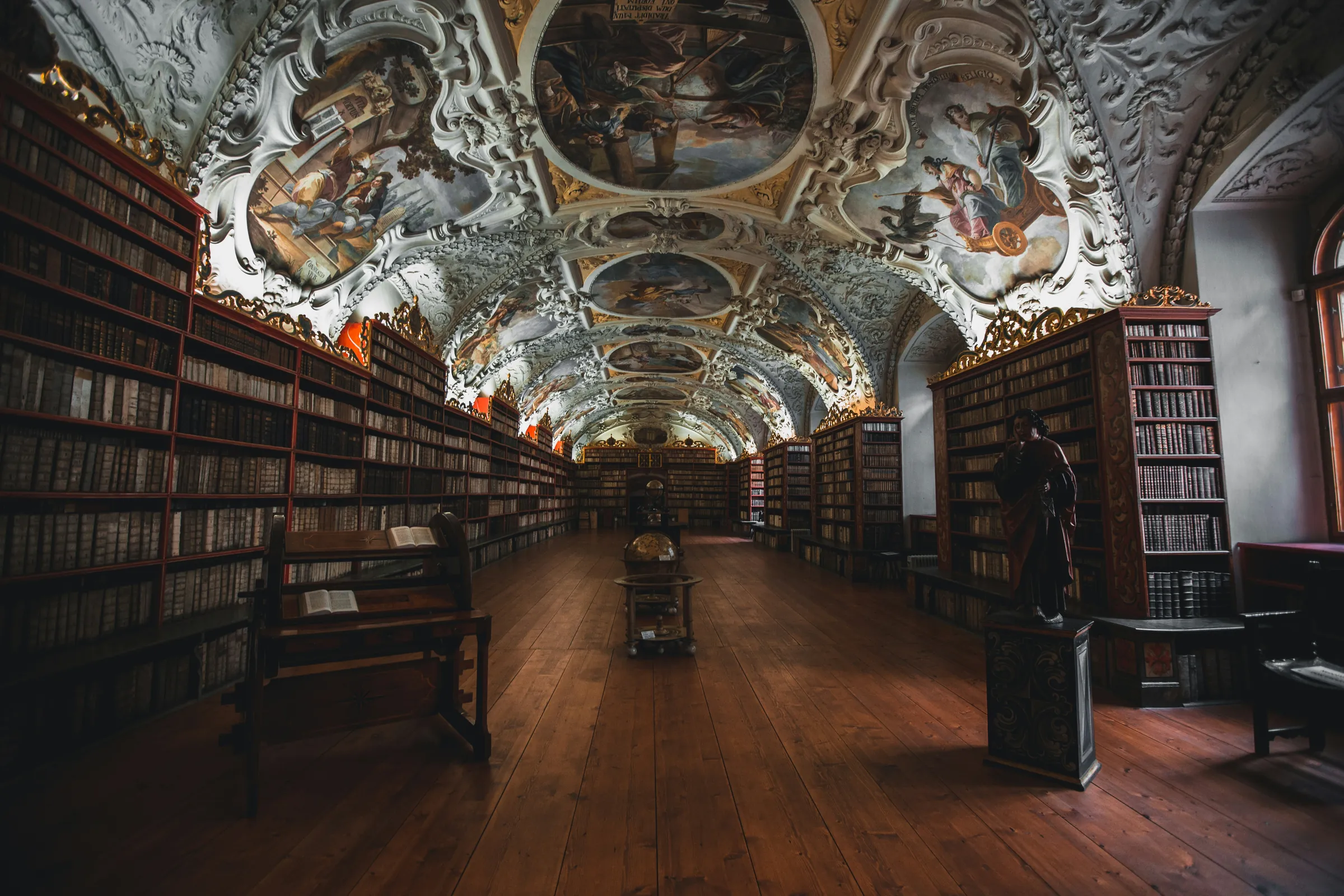
The wealth shows in every surface. Exotic hardwoods were shipped from Brazil to build the two storeys of shelving; gold leaf was applied across carved balconies and arches; the shelves were lacquered in Chinese-inspired chinoiserie patterns then in high fashion; and the ceilings were painted in illusionistic trompe-l'oeil by skilled Lisbon artists. A portrait of João V himself watches over the noble floor, a reminder that the library was a monument to a king as much as to learning. The result is widely regarded as the finest baroque library in Portugal and one of the great baroque interiors in Europe — a place where the resources of a transatlantic empire, at the height of Portugal's gold rush, were poured into the architecture of knowledge itself.
A library built to last
The Joanina's builders engineered preservation into the fabric of the building. The exterior walls were made extraordinarily thick — around 2.1 metres — and the entrance to the main hall closes with a heavy door of teak. Together these create a near-sealed environment that holds temperature and humidity remarkably stable, hovering around 18–20°C year-round regardless of the season outside. In an age long before mechanical climate control, this passive system was a sophisticated answer to the great enemies of old paper: heat, damp and the sharp swings between them that crack bindings and breed mould. The same logic explains why visitor numbers inside are capped and the door kept largely closed: every person who enters brings warmth and moisture the building is designed to exclude.
That stability is a large part of why the collection has survived so well. Books that would have warped, foxed or rotted in a less controlled space have endured here for three centuries, many still on the original shelves built for them. The library's design treated the protection of knowledge as seriously as its display — the same impulse that produced the gold leaf and the painted ceilings also produced the thick walls and the teak door. Splendour and conservation were, from the start, two sides of the same royal project, and it is the unglamorous engineering as much as the gold that has carried the Joanina intact through wars and revolutions that wrecked comparable libraries elsewhere in Europe.
The bats — three centuries of natural conservation
The Joanina's most celebrated guardians are biological. A colony of bats lives within the library and emerges at night to feed on the moths, silverfish and other insects that would otherwise devour the paper, glue and leather bindings of the books. This is not a curiosity but a working conservation system, and it has operated for some 300 years, predating by centuries the chemical and climate-controlled methods modern archives depend on. The Joanina is one of only two libraries in the world known to rely on bats in this way — the other being the library of the royal palace at Mafra, also in Portugal — which makes the pairing a distinctly Portuguese contribution to the history of book preservation.
The arrangement leaves a daily ritual visible to staff if not to daytime visitors. Each evening the long reading tables are covered with sheets of leather to protect them from the bats overnight; each morning the covers are removed and the floors are cleaned. It is a strikingly low-technology answer to a problem that modern archives spend fortunes on, and it endures because it works: the insects that destroy comparable collections elsewhere are kept in check by predators that ask for nothing but a place to roost. The bats are now inseparable from the library's identity — a piece of living heritage as much as the books themselves.
One of the world's oldest universities
The Joanina does not stand alone but at the heart of one of the oldest universities in continuous operation anywhere. The University of Coimbra traces its foundation to 1290, when it was first established in Lisbon; after moving back and forth between the two cities over the following centuries, it was settled permanently in Coimbra in 1537, taking over the former royal palace — the Paço das Escolas — as its core. For most of its history this university was the only one in Portugal, and it shaped the country's intellectual, scientific and administrative life for centuries.
That long continuity is what UNESCO recognised in 2013, when it inscribed 'University of Coimbra – Alta and Sofia' on the World Heritage List. The designation honours not just the Joanina but the whole historic university quarter — the hilltop Alta and the Rua da Sofia in the town below — as a place that, over more than seven centuries, has been a model and a reference for higher education across the Portuguese-speaking world. The library, built by a king at the empire's height, is the dazzling centrepiece of a far older and deeper institution.
Frequently asked
Who built the Biblioteca Joanina and when?
It was commissioned by King João V of Portugal — which is why it is called the 'Joanina' — and built between 1717 and 1728. It was funded largely by gold then flowing into Portugal from Brazil, and is regarded as the finest baroque library in the country.
Why is it called the Joanina library?
The name honours its royal patron, King João V (John V) of Portugal, who commissioned and paid for it in the early 18th century. A portrait of the king presides over the noble floor of the library he built.
How was the library funded?
Largely by the gold and wealth flowing into Portugal from its colony of Brazil during João V's reign. That windfall paid for the gold leaf, the exotic Brazilian hardwoods of the shelving, and the painted ceilings that make the library so lavish.
How do the bats protect the books?
A colony of bats living in the library emerges at night to eat the moths, silverfish and other insects that would otherwise damage the books — a natural pest-control system used for about 300 years. The Joanina is one of only two libraries in the world known to use bats this way, the other being Mafra.
Why have the books survived so long?
The library was engineered for preservation: walls around 2.1 metres thick and a heavy teak door keep the interior near 18–20°C year-round, with stable humidity. Combined with the bats' insect control, this has protected the collection for three centuries.
How old is the University of Coimbra?
It traces its foundation to 1290, when first established in Lisbon, and was settled permanently in Coimbra in 1537. It is one of the oldest universities in continuous operation in the world, and was inscribed by UNESCO in 2013.
When did the university become a UNESCO World Heritage Site?
In 2013, when UNESCO inscribed 'University of Coimbra – Alta and Sofia', recognising the hilltop university quarter and the Rua da Sofia below for their centuries-long role in higher education across the Portuguese-speaking world.