 Skip-the-line available
 What's Actually on the Shelves of the Biblioteca Joanina
Nearly 60,000 volumes of European printing from the 15th to the 18th century — what the books are, how they're arranged, and why scholars still call them up.
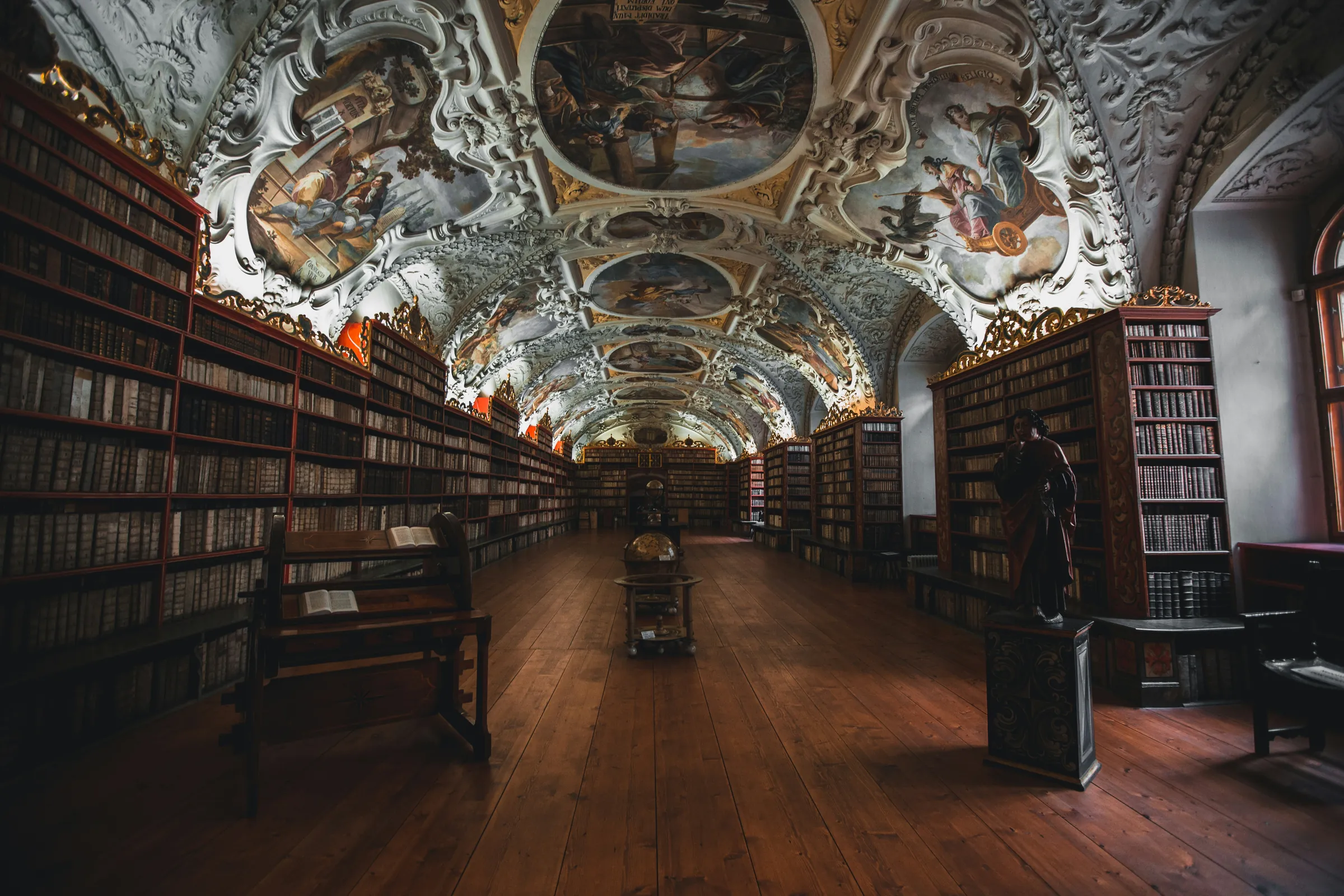
Everyone photographs the gold — or would, if photography were allowed — but almost nobody who files through the Biblioteca Joanina in their timed twenty minutes could tell you what the books actually are. That is a shame, because the collection is the point of the building. The gilded shelving, the two-metre walls, the teak door and the resident bats all exist to serve the tens of thousands of volumes standing exactly where eighteenth-century librarians placed them: by the university's own account, nearly 60,000 books representing the best of what was printed in Europe between the 15th and the 18th centuries. These are not props. They span law, theology, medicine, philosophy, history and the sciences; they were the working reference collection of Portugal's only university for well over a century; and — the detail that surprises visitors most — they can still be requested and read today. This guide is about the books themselves: what they are, how they are arranged, and why they have survived.
How many books — and why the numbers differ
Start with the number, because sources disagree and the disagreement is instructive. The University of Coimbra's visitor pages put the Joanina's holding at nearly 60,000 volumes. Other accounts — including some of our own pages — quote around 40,000, and both are defensible, because they count different things. The figure of roughly 40,000 corresponds to the books shelved on the noble floor, the gilded triple hall that visitors see; the larger figure takes in the building's full holdings, including the working floors below the showpiece level. A baroque library was a vertical institution, and the famous room is only its crown.
The building's three levels tell that story. Beneath the noble floor sits an intermediate floor that served as the library's working machinery — storage and staff spaces where books were managed rather than displayed — and beneath that, in a different register entirely, the old academic prison. The visitor's twenty minutes happen almost entirely in the top layer, which is precisely why the shelved collection there dominates the popular imagination and the lower figure dominates casual accounts. When the university says nearly 60,000, it is counting the institution, not just the theatre.
Either number places the Joanina among the most significant intact early-modern collections anywhere, but the right way to hear them is not as a boast about size. Plenty of libraries hold more books. What almost none hold is a coherent, closed, three-century-old collection still standing on the original shelves built for it, in the original order, in the original room — a time capsule of what an ambitious European university thought worth owning at the height of the Enlightenment. The count matters less than the completeness.
The subjects — a map of eighteenth-century knowledge
What did a royal university library collect in the age of João V? The Joanina's shelves answer with a curriculum: civil and canon law, theology, medicine, philosophy, history, geography, humanistic studies and the sciences. The weighting is revealing. Law and theology dominate, because Coimbra's core business for centuries was producing the magistrates, administrators and clergy who ran Portugal and its empire; medicine and the sciences grow through the collection as the eighteenth century's reforming spirit reaches Portugal. Walking the three halls, you are effectively walking a map of what an educated European was expected to know in 1750, drawn at royal expense.
The provenance is as impressive as the spread. The university describes the collection as representing the best of European printing from the 15th through the 18th centuries — which means the shelves carry not just Portuguese scholarship but the output of the great presses of Venice, Paris, Antwerp, Lyon and the German cities, gathered by an institution rich enough to buy well and old enough to have started early. The earliest material reaches back to the infancy of printing itself. A library assembled today with unlimited money could not reproduce it, because much of what stands here simply no longer exists elsewhere to buy.
It is also, unmistakably, a Catholic monarchy's library, and reading it that way adds a layer to the visit. The theology and canon law reflect an institution where the church and the crown were entwined; the portrait of João V presiding over the central hall — painted by Domenico Duprà in 1725 — makes explicit whose generosity, and whose glory, the room served. The Joanina was never a neutral warehouse of information. It was an argument, in gold and leather, that Portugal under its Magnanimous king belonged in the first rank of learned Europe.
For the visitor with twenty minutes and no Latin, the subjects still repay attention, because the shelving wears them. Look for the painted cartouches and lettered panels on the case-work that once guided readers to their discipline, and for the sheer physical rhetoric of the bindings — ranks of vellum and calf, tall folios of law below, smaller formats above, the visual grammar of a collection arranged for use rather than for show. You will not open a book, but you can read the library itself: which subjects earned the grandest runs of shelving, how the halls change character as the collection proceeds, and how a room designed in the 1720s manages to make the contents of sixty thousand spines legible at a glance. That, not the gold, is the connoisseur's pleasure here.
A working library, not a museum piece
The fact most visitors never learn: the Joanina is still, in a real if limited sense, in service. The university notes that roughly 750 works are requested from the collection each year — scholars calling up specific volumes for consultation, exactly as readers have done since the room opened. The books received their first readers in 1750; the library served as the university's principal collection from 1777 until the first half of the 20th century, when the modern General Library assumed the everyday burden; and the historic collection has remained consultable ever since. Three centuries on, the shelves still answer requests.
That continuity of use is rarer than it sounds. Most historic libraries that survive at all survive as sealed monuments — the books present but effectively retired, spines to the public, contents dark. The Joanina's collection remained catalogued, ordered and institutionally alive through every regime Portugal has run since the eighteenth century. When a researcher today needs a particular early edition of a legal commentary or a seventeenth-century medical treatise, there is a working process by which that book comes off a gilded shelf and onto a desk. The room is a monument that has never stopped being a tool.
For the visitor, this reframes the twenty-minute slot. You are not walking through a stage set; you are being briefly admitted to a functioning rare-books institution that happens to occupy the most beautiful room in Portugal. The ropes, the group limits, the ban on photography and the short stay all follow from that: the priority here is the working collection, and tourism is a guest in its house. Visitors who understand this tend to find the strictness of the visit easier to love — it is the same discipline that kept the books alive long enough for you to see them.
The shelves themselves — architecture in service of books
The bookcases of the Joanina are architecture, not furniture. Two storeys of shelving rise through each of the three halls, the upper level reached from a gallery balustrade, the whole structure carved, lacquered and gilded into a continuous decorative scheme. The university's description singles out the colour logic that visitors often sense before they consciously notice it: the ornament plays against a black ground in the first hall, red in the second and green in the third, so that the procession through the library is also a procession through a deliberate sequence of colour. Gilded chinoiserie decoration — the eighteenth century's fashion for the imagined East — patterns the cases throughout.
The furnishings continue the argument. Six great tables of precious tropical woods stand in the halls — the same tables the staff dress in leather each night against the bats — and the room's timber linings are painted to imitate marble, a baroque sleight of hand that let carpenters deliver what quarries could not. Above, the painted ceilings carry allegorical programmes whose figures, in the university's words, carry messages connected to the institution's ideals: knowledge, virtue and the union of learning with power. Every element points the same way — this is a room in which the display of books was treated as a sacred act.
Notice, too, what the design does quietly. The tall cases keep the books off the exterior walls, buffered from whatever damp the two-metre masonry admits; the gallery structure lets a small staff reach tens of thousands of volumes without ladders leaning against gilt; and the closed lower cupboards hid the working clutter every library generates. Baroque decoration gets the photographs — or would, were photography permitted on the noble floor — but the case-work is also simply excellent library engineering, which is why the collection it carries has needed no rescue in three hundred years.
Why the books survive — the vault around them
A collection is only as safe as its room, and the Joanina's room was engineered like a strongbox. The exterior walls run to about 2.11 metres of solid masonry; the single public entrance closes with a door of teak; and together they hold the interior at a near-constant 18–20°C with humidity around 60%, summer and winter, without a single machine. Those are almost exactly the conditions a modern conservator would specify for rare books, achieved passively, two centuries before anyone wrote the specification. The library does not contain a climate-control system. It is one.
The building's famous residents complete the defence. Two colonies of bats have roosted behind the shelving for roughly 250 years, emerging at night to hunt the insects — the moths, beetles and silverfish — whose larvae eat paper, paste and leather. Between the sealed stable climate, which denies insects the warm damp they multiply in, and the nightly patrol, which removes the survivors, the Joanina runs an integrated pest-management system of a sophistication conservation science only formalised in the twentieth century. The books, in short, are not lucky. They are defended.
This is also the honest answer to why your visit is short and dry-eyed about it. Every open door and every warm human body perturbs the climate the walls were built to hold; small timed groups, briskly cycled, are how the university admits the public without breaking the machine. The twenty minutes you get are not a ration of the experience — they are part of the conservation system, and the price of the collection still being there for the visitors who come after you. Few tickets anywhere buy entry into so precisely balanced a room.
Frequently asked
How many books are in the Biblioteca Joanina?
The University of Coimbra puts the holding at nearly 60,000 volumes, printed between the 15th and 18th centuries. Figures of around 40,000 are also widely quoted — they refer to the books shelved on the gilded noble floor that visitors see.
What subjects do the books cover?
Civil and canon law, theology, medicine, philosophy, history, geography, humanistic studies and the sciences — the working curriculum of Portugal's university in the early-modern age, drawn from the best European presses of the period.
Can you read or touch the books?
Not during a visit — the collection is protected and visitors keep to the floor of the halls. But the library is still a working institution: scholars request roughly 750 works a year for consultation through the university.
How old are the oldest books?
The collection represents European printing from the 15th century onwards — reaching back to the early decades of the printed book — through to the 18th century. The library itself received its first books in 1750.
Why are the three halls black, red and green?
The gilded ornament of the shelving is set against a different ground colour in each hall — black in the first, red in the second, green in the third — a deliberate baroque colour sequence that structures the procession through the library.
Why have the books survived so well?
The room is a passive vault: walls about 2.11 metres thick and a teak door hold the interior near 18–20°C and 60% humidity year-round, while resident bat colonies eat the insects that attack paper and bindings. Short timed visits protect that balance.